9 Best Polycarbonate Greenhouse Panels (October 2026)
The best polycarbonate greenhouse panels include the DGSL 14-Piece 0.16-Inch Polycarbonate Panels for standard repairs, the Storystore 14-Piece 0.16-Inch Polycarbonate Panels for cold frames, and the DGSL 14-Piece 0.24-Inch Polycarbonate Panels for thicker frames.
On this page (8 sections)
- How we chose polycarbonate greenhouse panels
- Compare these greenhouse panel sizes and thicknesses
- Polycarbonate greenhouse panels for different projects
- How do you choose the right greenhouse panel thickness?
- Do light transmission and UV protection affect plant choice?
- How should you measure, cut and install polycarbonate sheets?
- What common mistakes should you avoid?
- Which polycarbonate greenhouse panels should you choose?
The DGSL 14-Piece 0.16-Inch Polycarbonate Panels suit many greenhouse repairs, with 14 twin-wall sheets sized 4 x 2 ft. These polycarbonate greenhouse panels are a practical starting point when you need common-size replacement sheets; choose VEVOR for its larger stated pack coverage or FAHKNS for 0.32 in panels.
Rigid polycarbonate sheets can replace a damaged greenhouse roof or wall, cover a cold frame, or form a new panel enclosure. The right pack depends on more than total area: thickness must match the frame, sheet dimensions must fit the openings, and the pack should leave enough material for cuts and mistakes.
If your structure uses a flexible cover instead of rigid sheets, compare greenhouse plastic sheeting. For a walk-in greenhouse with a worn fabric cover, how to replace a greenhouse cover can help you plan the repair before choosing a material.
Our picks at a glance
-
1
 Best for standard repairs
DGSL 14-Piece 0.16-Inch Polycarbonate Panels
8.8/10 our score
See it on Amazon -
2
 Best for cold frames
Storystore 14-Piece 0.16-Inch Polycarbonate Panels
8.5/10 our score
See it on Amazon -
3
Best for thicker frames
DGSL 14-Piece 0.24-Inch Polycarbonate Panels
8.4/10 our score
See it on Amazon
- 4
 Check it
VEVOR 15-Pack 0.24-Inch Polycarbonate Panels
Best for measured coverage - 5
 Check it
EVERECO 10-Piece 0.16-Inch Polycarbonate Panels
Best for bright growing spaces - 6
 Check it
VEVOR 24-Pack 0.16-Inch Polycarbonate Panels
Best for large thin-panel jobs - 7
 Check it
FAHKNS 6-Pack 0.32-Inch Polycarbonate Panels
Best for deep panel channels - 8
 Check it
RITOLLO 14-Pack 6 ft 0.24-Inch Polycarbonate Panels
Best for tall wall sections - 9
 Check it
Sinimaka 10-Pack 8x4 ft Polycarbonate Panels
Best for broad roof spans
How we chose polycarbonate greenhouse panels
We compared panel dimensions, thickness, pack size, construction and stated coverage with common repair and build needs. A useful choice must match the frame and project size, so a larger pack or thicker sheet does not automatically rank higher.
Where brands state light transmission, UV protection or temperature ranges, those claims help describe the intended use. They are not interchangeable: a light figure says how much light the brand says passes through, while thickness and construction affect fit and insulation.
Compare these greenhouse panel sizes and thicknesses
Start with the dimensions and thickness your frame accepts, then use coverage and other features to narrow the choices. The table compares the most useful planning details across all nine options.
| Product | Best for | Panel size | Thickness | Pack size | Our score |
|---|---|---|---|---|---|
| DGSL 14-Piece 0.16-Inch Polycarbonate Panels | standard repairs | 4 x 2 ft | 0.16 in | 14 panels | 8.8 |
| Storystore 14-Piece 0.16-Inch Polycarbonate Panels | cold frames | 47.2 x 23.6 in | 0.16 in | 14 panels | 8.5 |
| DGSL 14-Piece 0.24-Inch Polycarbonate Panels | thicker frames | 4 x 2 ft | 0.24 in | 14 panels | 8.4 |
| VEVOR 15-Pack 0.24-Inch Polycarbonate Panels | measured coverage | 47.6 x 23.8 in | 0.24 in | 8.3 | |
| EVERECO 10-Piece 0.16-Inch Polycarbonate Panels | bright growing spaces | 4 x 2 ft | 0.16 in | 10 panels | 8.1 |
| VEVOR 24-Pack 0.16-Inch Polycarbonate Panels | large thin-panel jobs | 47.6 x 23.8 in | 0.16 in | 8.0 | |
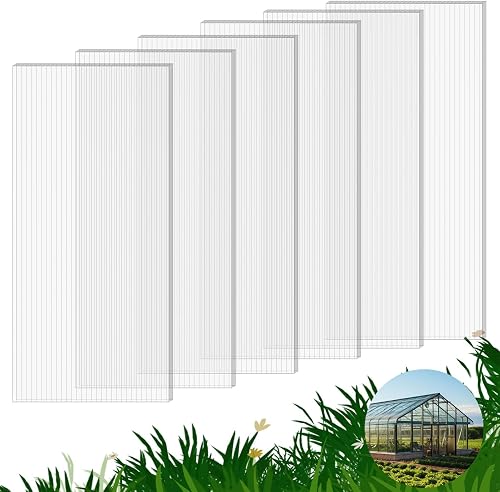
| FAHKNS 6-Pack 0.32-Inch Polycarbonate Panels | deep panel channels | 4 x 2 ft | 0.32 in | 6 panels | 7.6 |
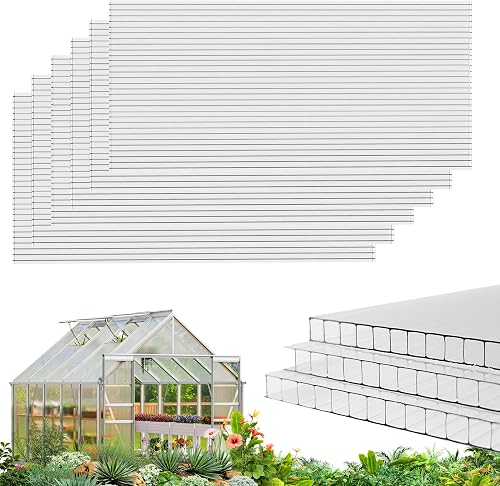
| RITOLLO 14-Pack 6 ft 0.24-Inch Polycarbonate Panels | tall wall sections | 6 x 2 ft | 0.24 in | 14 panels | 7.2 |
| Sinimaka 10-Pack 8x4 ft Polycarbonate Panels | broad roof spans | 8 x 4 ft | 0.24 in | 10 panels | 7.1 |
Polycarbonate greenhouse panels for different projects
The picks below cover ordinary repairs, larger roof areas, narrow or tall sections, and custom projects. Decide first whether your frame takes 0.16, 0.24 or 0.32 in sheets, then check the panel format and pack count.
DGSL 14-Piece 0.16-Inch Polycarbonate Panels: Best for standard repairs
- 14 twin-wall sheets
- 4 x 2 ft each
- 0.16 in thick
- DGSL states 80% light transmission
Fourteen 4 x 2 ft twin-wall sheets suit greenhouse repair work. DGSL states 80% light transmission and a working temperature range from -44°C to 120°C.
Pros
- 14 sheets in a 4 x 2 ft size
- Twin-wall construction
- DGSL states 80% light transmission
Cons
- Pack coverage is not stated
- Check that the panels fit your frame
DGSL’s 14-sheet pack is a strong fit for routine repairs where the frame uses 4 x 2 ft panels and 0.16 in thickness. Twin-wall construction and a familiar sheet size make it a straightforward option for replacing several damaged roof or wall sections.
DGSL states 80% light transmission and a working temperature range from -44°C to 120°C. The brand also describes the panels as shatterproof, but you should still support and fasten each sheet according to the frame design.
The total pack coverage is not stated, so calculate it from the area of the sheets and allow for cuts. Skip this pack if your frame needs a different thickness or panel width, even if the overall roof area seems close.
Storystore 14-Piece 0.16-Inch Polycarbonate Panels: Best for cold frames
- 14 twin-wall sheets
- 47.2 x 23.6 in each
- 0.16 in thick
- UV-resistant
The 14-panel pack is described for greenhouse repairs, cold frames and other garden projects. Storystore describes the sheets as UV-resistant and easy to cut.
Pros
- Pack of 14 sheets
- Twin-wall construction
- Described for greenhouse and cold-frame use
Cons
- Pack coverage is not stated
- No light transmission figure is given
Storystore’s 14 twin-wall sheets measure 47.2 x 23.6 in, making them a useful choice for cold frames, small repairs and mixed garden projects. The dimensions are slightly smaller than 4 x 2 ft, so they are best when you can work from the actual sheet size rather than a standard opening.
Storystore describes the sheets as UV-resistant and easy to cut. Their channels create an insulating air space, and the stated uses include cold frames, plant stands and garden covers.
Choose them when you need a flexible set of smaller panels for repair or DIY work. Skip them if you need a published coverage figure or a stated light transmission percentage to plan around.
DGSL 14-Piece 0.24-Inch Polycarbonate Panels: Best for thicker frames
- 14 twin-wall sheets
- 4 x 2 ft each
- 0.24 in thick
- DGSL states 80% light transmission
This version has the same 4 x 2 ft sheet size and 14-panel count as the thinner DGSL option, with 0.24 in thickness. DGSL states 80% light transmission and a working temperature range from -44°C to 120°C.
Pros
- Thicker than the 0.16 in DGSL option
- 14 sheets in a 4 x 2 ft size
- Twin-wall construction
Cons
- Pack coverage is not stated
- Check that your frame accepts 0.24 in panels
This DGSL pack is for frames designed around 0.24 in sheets. It keeps the 4 x 2 ft dimensions and 14-panel count of the thinner DGSL option, so the main decision is whether your frame can hold the thicker panel.
DGSL states 80% light transmission and a working temperature range from -44°C to 120°C. The twin-wall panels are also described as shatterproof.
Measure the groove or channel width at several points before ordering, especially if the old sheets have warped or the frame is worn. Skip this version if your frame was built for 0.16 in panels and cannot be adjusted to secure a thicker sheet.
VEVOR 15-Pack 0.24-Inch Polycarbonate Panels: Best for measured coverage
- 15 panels
- 47.6 x 23.8 in each
- 0.24 in thick
- Up to 118.2 sq ft stated coverage
VEVOR states coverage of up to 118.2 sq ft for this 15-panel pack. The panels have a double-layer honeycomb design and are described as easy to cut or bend.
Pros
- Stated coverage helps estimate pack needs
- 0.24 in thickness
- VEVOR states 80% light transmission
Cons
- Panels measure 47.6 x 23.8 in
- Check that the panels fit your frame
VEVOR’s 15-panel set suits projects where a stated coverage estimate helps with planning. The brand gives up to 118.2 sq ft for the pack, with each 0.24 in panel measuring 47.6 x 23.8 in.
The double-layer honeycomb design is described as impact-resistant. VEVOR states 80% light transmission and 98% UV blocking, and says the panels can be cut or bent for custom areas.
Choose this pack for a medium-sized replacement or new roof when its dimensions fit your frame. Skip it if you are patching openings made for 4 x 2 ft sheets and cannot change the support layout.
EVERECO 10-Piece 0.16-Inch Polycarbonate Panels: Best for bright growing spaces
- 10 panels
- 4 x 2 ft each
- 0.16 in thick
- EVERECO states over 90% light transmission
EVERECO states over 90% light transmission and describes a UV-resistant coating. The pack contains 10 sheets.
Pros
- EVERECO states over 90% light transmission
- 4 x 2 ft panel size
- 10 sheets in the pack
Cons
- Fewer sheets than several picks here
- Light transmission is a brand claim
EVERECO’s 10-panel pack is aimed at bright growing spaces where the stated light figure is a priority. Each sheet is 4 x 2 ft and 0.16 in thick, and the brand states over 90% light transmission.
EVERECO also describes a UV-resistant coating and says the sheets are suitable for outdoor garden structures. The pack has fewer sheets than several other options here, so it may be easier to size for a small repair than a full greenhouse rebuild.
Choose it when your frame uses the listed dimensions and you want to compare the brand’s higher light claim. Skip it if you need a larger pack or want a stated total coverage figure.
VEVOR 24-Pack 0.16-Inch Polycarbonate Panels: Best for large thin-panel jobs
- 24 panels
- 47.6 x 23.8 in each
- 0.16 in thick
- Up to 189.1 sq ft stated coverage
VEVOR states coverage of up to 189.1 sq ft for this 24-panel pack. Its 0.16 in thickness may suit frames built for thinner sheets.
Pros
- Largest stated pack coverage here
- 24 panels in one set
- VEVOR states 80% light transmission
Cons
- The pack may be more than a small repair needs
- Compare stated coverage with your measurements
The VEVOR 24-pack suits a large project using thinner panels. It uses 0.16 in sheets measuring 47.6 x 23.8 in, and VEVOR states coverage of up to 189.1 sq ft.
VEVOR states 80% light transmission and 98% UV blocking for this set. Its double-layer honeycomb panels are described as impact-resistant and suitable for cutting or bending.
Measure all roof and wall sections before choosing the pack. This option is likely excessive for one or two broken panels, and its dimensions may not line up with an existing 4 x 2 ft layout.
FAHKNS 6-Pack 0.32-Inch Polycarbonate Panels: Best for deep panel channels
- Pack of 6
- 4 x 2 ft each
- 0.32 in thick
- Twin-wall construction
The 0.32 in thickness is the main reason to consider this pack. FAHKNS describes the panels as twin-wall and states 80% light transmission.
Pros
- Thickest option in this roundup
- 4 x 2 ft panel size
- Protective film is described on both sides
Cons
- The title and specs give conflicting panel counts
- Check the pack count before buying
FAHKNS is the thickest option here at 0.32 in, with 4 x 2 ft sheets. It may suit a frame built for deeper channels or a project where that thickness is a firm requirement.
FAHKNS describes the sheets as twin-wall, shatterproof and able to transmit 80% of light. The panels are described with protective film on both sides, which should be removed before installation.
There is a conflict between the product name and the pack size about how many panels are included. Choose it only after confirming the count and checking that the frame accepts 0.32 in sheets.
RITOLLO 14-Pack 6 ft 0.24-Inch Polycarbonate Panels: Best for tall wall sections
- 14 panels
- 6 x 2 ft each
- 0.24 in thick
- Twin-wall construction
Each sheet is 6 x 2 ft. RITOLLO describes the twin-wall sheets for greenhouse roofs, walls and cold frames.
Pros
- 6 ft panel format
- 14 sheets per pack
- 0.24 in thickness
Cons
- Long panels may need careful handling
- Check fit and support points for your frame
RITOLLO’s 6 x 2 ft format is aimed at tall wall sections or layouts where longer panels can cover more height. The 14 sheets are 0.24 in thick and use twin-wall construction.
RITOLLO describes the panels as UV-protected and suitable for greenhouse roofs, wall repairs and cold frames. Their longer format means you should plan how to carry each sheet through gates and around the greenhouse before cutting.
Choose this pack if your frame has a 6 ft opening and supports the sheet along its length. Skip it for short openings where trimming would leave large offcuts or weaken the available coverage.
Sinimaka 10-Pack 8x4 ft Polycarbonate Panels: Best for broad roof spans
- 10 panels
- 8 x 4 ft each
- 0.24 in thick
- Twin-wall construction
The 8 x 4 ft format suits larger sections where fewer, larger sheets make sense. Sinimaka states 89% light transmission and says the panels can be cold-bent.
Pros
- Large 8 x 4 ft sheets
- Twin-wall construction
- Sinimaka states 89% light transmission
Cons
- Large sheets need room for handling and cutting
- Check fit before buying
Sinimaka’s 8 x 4 ft panels suit broad roof spans where large sheets can reduce the number of joints. Each panel is 0.24 in thick, and the 10-pack gives you large sections to plan around.
Sinimaka states 89% light transmission and says the panels block 99.9% of UV rays. The brand also describes the sheets as cuttable and cold-bendable, which may help with curved designs when the frame and channel direction allow it.
Choose this format when you have room to move, support and cut large sheets. Skip it for tight access, small patch jobs or frames with narrow panel openings.
How do you choose the right greenhouse panel thickness?
Match the panel thickness to the frame’s grooves, supports and fasteners before weighing other features. These options range from 0.16 to 0.32 in, and a thicker sheet can be unusable if it will not seat securely.
If you are replacing one panel, measure the old sheet and the frame channel rather than relying on a general size label. Check the depth and width of the slot, the distance between supports, and the way the panel is retained at the edges.
Thinner sheets can make sense when the frame was designed for them and the goal is a direct replacement. Thicker panels are a fit only when the frame accommodates them; added thickness alone does not make a panel compatible or guarantee a better result.
If the structure is a portable tunnel with a flexible cover, rigid panels may not suit its frame. Compare the differences in PE and PVC greenhouse covers before choosing a replacement material.
What panel size fits your frame?
Use the frame opening and support spacing to decide the panel dimensions. The picks include common 4 x 2 ft sheets, slightly smaller 47.2 x 23.6 in sheets, near 4 x 2 ft VEVOR sheets, 6 x 2 ft panels and large 8 x 4 ft panels.
Measure the clear opening in more than one place because a greenhouse frame may not be perfectly square. Note where sheets overlap or sit inside a channel, and confirm the final cut leaves enough material for secure fastening.
Longer and wider panels can reduce the number of joints, but they also need more space for handling. For a repair, a panel that is easy to carry and position can be more useful than a larger sheet that creates excess offcuts.
How much coverage should you buy?
Measure every roof and wall section that needs panels, then add the areas together. Compare that number with a pack’s stated coverage when available, and leave room for overlaps, cuts and unusable offcuts.
The VEVOR 15-pack states up to 118.2 sq ft, while its 24-pack states up to 189.1 sq ft. The other options do not state total pack coverage, so estimate from sheet dimensions and pack count instead.
Treat pack coverage as a planning figure, not a guarantee that every square foot will be usable. Panel layout, frame edges and cuts affect how much area the sheets cover in practice.
Do light transmission and UV protection affect plant choice?
Light transmission and UV protection describe different things, so compare them separately. A higher stated light figure may matter when you want more light to pass through, while a UV claim concerns protection from ultraviolet rays.
DGSL and VEVOR state 80% light transmission, EVERECO states over 90%, and Sinimaka states 89%. Several brands describe their panels as UV-resistant or UV-protected, and VEVOR and Sinimaka give specific UV-blocking claims.
These are brand claims, and the figures do not make the panels interchangeable. Consider the light needs of your plants, the amount of sun your site receives, and whether the frame can use the panel you prefer.
For a greenhouse with heat buildup, changing the panels may not solve the whole problem. See how to cool a greenhouse in summer heat for ways to manage ventilation and temperature alongside the cover choice.
How should you measure, cut and install polycarbonate sheets?
A careful layout prevents wasted panels and helps each sheet sit securely. Measure the frame first, mark cuts on the panel, and follow the instructions for the specific material and cutting method.
Some picks are described as cuttable with a utility knife or scissors; VEVOR describes its panels as cuttable or bendable, and Sinimaka says its sheets can be cold-bent. Use suitable eye and hand protection, work on a stable surface, and keep the panel supported so it does not flex unexpectedly.
Before cutting, identify the channel direction and support locations. FAHKNS describes its flute running along the long side and the panels sliding into grooves, while other frames may use different methods, so check how your structure holds its sheets.
Remove protective film where the panel instructions call for it. VEVOR says to peel off the protective film before installation, and FAHKNS describes film on both sides that should be removed before use.
For a complete walk-in structure rather than a panel replacement, follow the sequence in how to set up a walk-in greenhouse. Secure the frame and confirm the support points before placing new panels.
What common mistakes should you avoid?
The most costly mistake is choosing by pack size before checking frame fit. A large coverage number cannot compensate for a panel that is too thick, too narrow or unsupported by the existing structure.
Other common mistakes include:
- Measuring the outside frame instead of the opening. Account for the part of each sheet that sits inside grooves or overlaps another panel.
- Ignoring channel direction. Cut and position twin-wall panels with the frame’s support and drainage needs in mind.
- Forgetting access and handling. An 8 x 4 ft sheet may be hard to carry into a small yard or maneuver around a finished greenhouse.
- Assuming all UV or light claims are the same. Compare the specific figures and descriptions for the panel you plan to use.
- Cutting before planning the layout. Mark every panel and reuse offcuts only where their size and support are suitable.
- Leaving film in place. Remove protective film before installation where the instructions require it.
If the existing structure is unstable, repair or anchor its frame before attaching rigid panels. The guide to anchoring a pop-up or walk-in greenhouse covers that separate step.
Which polycarbonate greenhouse panels should you choose?
Choose the 0.16 in DGSL 14-pack for a familiar 4 x 2 ft repair size, the 0.24 in DGSL pack when your frame needs thicker sheets, or Storystore for smaller panels suited to cold frames and mixed garden work. For a larger measured project, compare VEVOR’s stated pack coverage; choose Sinimaka only if its broad 8 x 4 ft format is practical to handle.
Skip any panel that does not match your frame’s channel, support spacing or access limits. Measure first, choose the pack around the usable area, and then compare light and UV claims for your growing space.
If your greenhouse needs a new structure as well as new panels, see our guide to outdoor greenhouses for home gardeners.
Our top 3 picks at a glance
-
1
Best for standard repairs
DGSL 14-Piece 0.16-Inch Polycarbonate Panels
8.8/10 our score
See it on Amazon -
2
Best for cold frames
Storystore 14-Piece 0.16-Inch Polycarbonate Panels
8.5/10 our score
See it on Amazon -
3
Best for thicker frames
DGSL 14-Piece 0.24-Inch Polycarbonate Panels
8.4/10 our score
See it on Amazon
Frequently asked questions
What thickness polycarbonate greenhouse panels should I choose?
Choose panels that fit your frame's grooves, supports and fasteners. The options here range from 0.16 to 0.32 in, and a thicker panel may not fit a frame made for thinner sheets.
Check the frame's panel dimensions before replacing a roof or wall.
Are twin-wall polycarbonate panels good for a greenhouse?
Twin-wall panels have two layers with channels between them. Several picks here use that construction, which can provide insulation while letting natural light into the greenhouse.
Compare the panel thickness, stated light transmission and fit with your frame before choosing.
How do I estimate how many greenhouse panels I need?
Measure each roof or wall section, add the areas together, and compare that total with a pack's stated coverage when available. Leave room for overlaps, cuts and unusable offcuts.
Panel dimensions and coverage can vary, so use the measurements for the option you plan to buy.
Can polycarbonate greenhouse panels be cut to size?
Some panels are described as cuttable with a utility knife or scissors, while others can also be cut or bent for custom spaces. Follow the instructions for the specific panel and use suitable eye and hand protection.
Plan cuts around the frame's support points and channel direction.
Do polycarbonate greenhouse panels block UV rays?
Several options are described as UV-resistant or UV-protected, and some brands state a specific UV-blocking figure. Those claims vary by panel, so check the option you plan to buy rather than assuming every sheet offers the same protection.
Light transmission and UV protection are separate details to compare.


