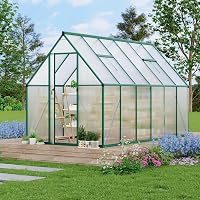
7 Best Greenhouse Kits for Windy Areas (November 2026)
The best greenhouse kits for windy yards include the Backyard Discovery Poppy 9' x 6' Cedar for exposed backyards, the Backyard Discovery Bellerose 9' x 6' White for heavy snow and wind, and the MUPATER 6'x10' Wooden Greenhouse for Outdoor for a longer cedar build.
On this page (9 sections)
- The best greenhouse kits for windy areas, ranked
- How do these greenhouse kits compare side by side?
- How we compared these kits
- What makes greenhouse kits for high wind areas hold up?
- How do you anchor a greenhouse in a windy yard?
- Do vents and fans matter in a windy greenhouse?
- Wood, aluminum or a mini cover: which suits your yard?
- Where should you put a greenhouse to cut wind exposure?
- Which greenhouse kit should you buy for a windy yard?
The best greenhouse kit for high wind areas is the Backyard Discovery Poppy 9' x 6' Cedar, because it pairs a cedar frame with a stated 100 mph wind figure. Backyard Discovery says that figure holds when you anchor the kit as its instructions specify.
Greenhouse kits for high wind areas come down to three things: frame weight, panel thickness and how well the base is fixed down. The Poppy covers all three better than anything else in this group.
Five of the picks are walk-in kits, one is a small portable cover and one is a solar fan for venting a sealed space. If you want a wider look at kit types before narrowing to wind, see our guide to backyard greenhouse kits.
Our picks at a glance
-
1
-
2
 Best for heavy snow and wind
Backyard Discovery Bellerose 9' x 6' White
9.5/10 our score
See it on Amazon -
3
 Best for a longer cedar build
MUPATER 6'x10' Wooden Greenhouse for Outdoor
9.0/10 our score
See it on Amazon
- 4
 Check it
ZIZIWIN 5.5" Solar Chicken Coop Fan 3
Best for adding airflow without wiring - 5
 Check it
Reljofum 6'X11' Aluminum-Framed Polycarbonate Greenhouse
Best for a low aluminum frame - 6
 Check it
Yesker Mini Greenhouse 36"x18"x33" Portable Small Green
Best for patio pots and herbs - 7
 Check it
PABIMIA 10x18 FT Aluminum Greenhouse
Best for a large growing space
The best greenhouse kits for windy areas, ranked
The Poppy is the best pick overall, and each of the other six fits a narrower need. Our score weighs specs and features against what you're shopping for.
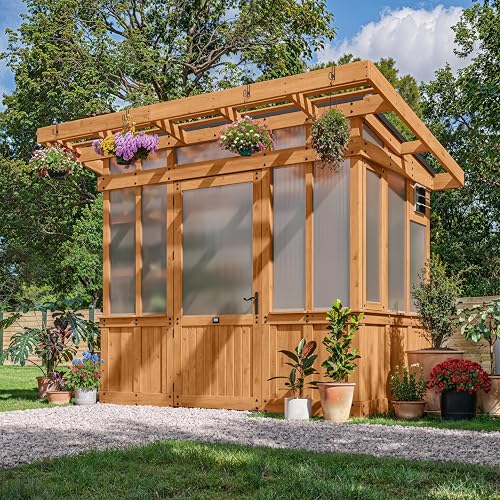
Backyard Discovery Poppy 9' x 6' Cedar: Best for exposed backyards
- Pro-Tect tested to 100 mph winds when anchored
- 50 sq ft interior
- Temperature-activated exhaust fan
- PowerPort with 3 outlets and 3 USB ports
A cedar walk-in with a stated 100 mph wind figure, built-in shelves and a fan. It is the strongest all-round answer for a windy yard.
Pros
- Stated 100 mph wind figure when anchored
- 26 linear feet of fixed staging shelves
- 5-year warranty
Cons
- Lower snow rating than the Bellerose
- Less floor area than the PABIMIA
The Poppy is the best pick for most windy backyards because it pairs a full cedar frame with the clearest wind figure in this group. Backyard Discovery says it is Pro-Tect tested to withstand winds up to 100 mph when anchored as its instructions specify.
That condition matters, so plan the base before you order. At 9 x 6 ft with 50 square feet inside, it is a compact footprint that is easier to fix down than the largest kits here.
Backyard Discovery says the 4-wall polycarbonate roof and window panels retain heat 30% better than standard double-wall. Inside are 26 linear feet of fixed staging shelves, a 4-tiered rack, 4 plant hooks and a PowerPort with 3 outlets and 3 USB ports (power source not included).
A temperature-activated exhaust fan and an easy-open window handle airflow, and a 5-year warranty covers the kit.
The trade-off is snow: its 2,600 lb rating sits below the Bellerose's 3,700 lb, and it has less floor than the PABIMIA.
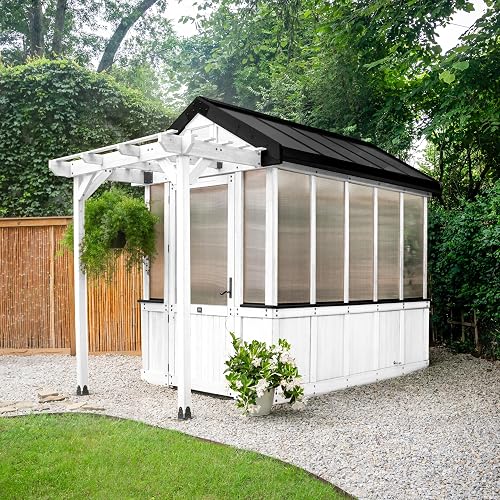
Backyard Discovery Bellerose 9' x 6' White: Best for heavy snow and wind
- Pro-Tect tested to 3,700 lb snow load and 100 mph winds when anchored
- 54 sq ft interior
- Attached pergola
- Exterior and interior hose hook-ups
The same 100 mph figure as the Poppy plus the highest snow rating here. The pergola adds style and height.
Pros
- 3,700 lb snow load rating
- 54 sq ft of floor
- White stain with pergola over the entrance
Cons
- Taller than the Poppy at 112.25 in
- Weighs 798.1 lb
The Bellerose is the pick when wind and heavy snow both hit your yard. Backyard Discovery says it is Pro-Tect tested to 3,700 lb or 30 inches of snow load and winds up to 100 mph, again when anchored as instructed.
It matches the Poppy's 9 x 6 ft footprint but gives 54 square feet inside, with 13 linear feet of lower staging, 6 feet of upper staging and 4 plant hooks.
The white stain and attached pergola over the entrance suit a front-yard or patio setting. The same exhaust fan, easy-open window, PowerPort and 5-year warranty carry over.
Hose hook-ups, inside and outside, make watering simpler on days you don't want to carry cans through the wind.
Its 4-wall polycarbonate roof and window panels carry the same 30% heat-retention claim as the Poppy, so warmth is not what separates the two.
The trade-off is height and weight. It stands 112.25 in tall against the Poppy's 102.24 in and weighs 798.1 lb, so the base needs to be solid.
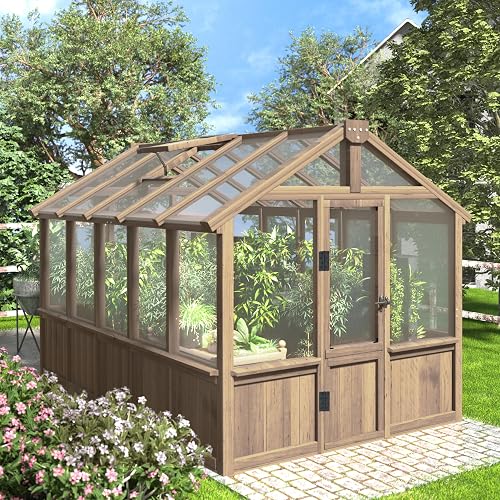
MUPATER 6'x10' Wooden Greenhouse for Outdoor: Best for a longer cedar build
- Cedar wood frame
- 6mm polycarbonate panels
- Lockable door
- Adjustable roof windows
A 6 x 10 ft cedar walk-in with thick panels and a door that locks. It is lighter than the Backyard Discovery kits.
Pros
- 6mm polycarbonate panels
- Lockable door
- Instructions and tools included
Cons
- No shelves or outlets named
- Lighter than the other cedar kits, so the base matters
The MUPATER suits gardeners who want more length than the 9 x 6 ft kits. It is a 6 x 10 ft walk-in with a cedar frame and 6mm polycarbonate panels, and MUPATER says the structure is built to stay stable in strong winds and heavy rain.
The panels are multi-layer, and MUPATER says they give up to 99.99% UV protection while letting light through.
A lockable front door keeps tools and pots secure, and adjustable roof windows let you set how far the vents open. Instructions and tools come with it.
At 282.4 lb it is much lighter than the Bellerose, so anchoring does more of the work.
The trade-off is that Backyard Discovery is the only brand here that puts a wind speed on its kits, and it also adds built-in shelves and power outlets. The listing names no shelves or outlets, so plan for your own benches.
Choose the MUPATER when you want 60 square feet of floor and a locking door without those extras.
ZIZIWIN 5.5" Solar Chicken Coop Fan 3: Best for adding airflow without wiring
- 30W solar panel
- Detachable fan and panel
- IP67 waterproof
- Plug-and-play cord with on/off switch
A solar fan kit for a sturdy, shut-up greenhouse that traps heat. It adds airflow without running power to the site.
Pros
- No battery or wiring needed
- Panel and fan detach
- 2-year warranty
Cons
- Runs in daylight only
- Not a greenhouse
The ZIZIWIN is not a greenhouse. It is a solar fan kit, and it earns its place because a sturdy, wind-tight greenhouse also traps heat.
The 30W kit has a 5.5-inch fan and a monocrystalline solar panel. ZIZIWIN says the fan reaches 3200 RPM at full speed and suits spaces up to about 190 sq ft, enough for the PABIMIA's 180 square feet of floor.
The fan and panel detach, so the panel sits outside in the sun while the fan mounts for exhaust or intake. The kit includes a mounting bracket, plates, screws, nylon ties, a plug-and-play cord and installation tools, and the cord has an on/off switch.
It runs on daylight with no battery, so speed drops on cloudy days and it stops at night. ZIZIWIN gives it IP67 waterproofing and a 2-year warranty.
Dual metal protective nets and a heavy-duty aluminum build are meant to resist impacts.
Buy it as an add-on for a hot, shut-up kit, not as your main purchase.
Reljofum 6'X11' Aluminum-Framed Polycarbonate Greenhouse: Best for a low aluminum frame
- Reinforced aluminum frame
- 6mm double-layer polycarbonate panels
- Roof vent
- 76.77 in overall height
A 52.7 lb aluminum kit that sits low to the ground. The thick panels and strengthened corners suit a lot where height is a worry.
Pros
- Low 76.77 in height
- 6mm double-layer panels
- Numbered parts for assembly
Cons
- Narrow 22.83 in door
- One roof vent
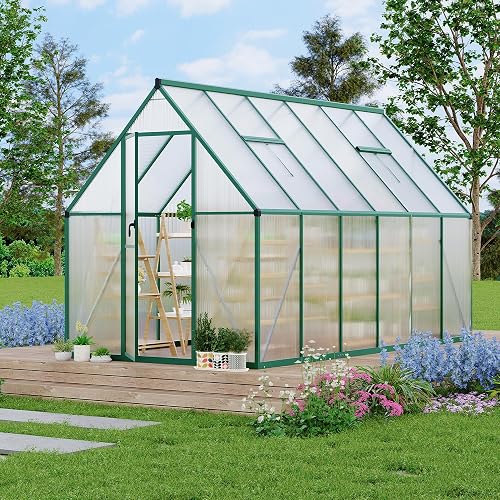
The Reljofum is the pick for a low, light aluminum kit on a tight or exposed site. It is 6 x 11 ft, 76.77 in tall and weighs 52.7 lb.
Reljofum says the reinforced aluminum frame and strengthened corners are built for strong winds, rain and snow. With so little weight, the anchors and base carry the load.
The 6mm double-layer polycarbonate panels match the MUPATER's thickness and beat the PABIMIA's 4mm. One roof vent measures 20.08 x 21.77 in.
Reljofum describes the double-layer diffusion pattern as spreading light through the space, and says the panels keep warmth in and block UV for four-season use.
Reljofum says each part is numbered and only the embedded parts need screwing, which is meant to shorten assembly.
The door is 22.83 in wide and 60.63 in tall, so you duck in and a wheelbarrow won't fit. That narrow door is the trade-off, along with one vent against the PABIMIA's two.
Choose it for a low-profile frame where height is the worry.
Yesker Mini Greenhouse 36"x18"x33" Portable Small Green: Best for patio pots and herbs
- Clear PVC cover
- Powder-coated iron frame
- Two zippered top doors
- Extended cover bottom for weights
A 3 lb tool-free cover for a few pots. Weight it down on the cover skirt in windy weather.
Pros
- Assembles without tools
- Extended bottom for weights
- Moves indoors or out
Cons
- Not a walk-in
- Light, so it needs weights
The Yesker is the pick for herbs, seedlings and potted plants on a patio or balcony. At 36 x 18 x 33 inches (the spec table lists 36 in tall, so plan for the larger figure) it is a cover, not a walk-in.
A clear PVC cover over a powder-coated iron frame lets light in, and two semi-circular zippered doors on top give you access and ventilation.
At 3 lb, wind is its weak point, but Yesker built in an extended cover bottom where you can add weights in windy conditions. Bricks or sandbags on that skirt hold it down.
It assembles without tools and moves indoors or out as the seasons change. Because all the components are removable, you can break it down and carry it to a porch, sunroom or garden.
The trade-off is scale: you can't stand inside, and it has none of the shelves of the walk-in kits. Pick it to protect a few pots, and move it against a wall when a gale is forecast.
PABIMIA 10x18 FT Aluminum Greenhouse: Best for a large growing space
- Powder-coated aluminum frame
- 4mm double-wall polycarbonate panels
- Adjustable roof vent
- 6'8" standing room
The largest kit here, with a gutter and two vents. Give it a firm base and a spot with some shelter.
Pros
- Largest floor area in the group
- Integrated drainage gutter
- 98 in peak height
Cons
- Biggest surface for wind to catch
- 4mm panels are thinner than the 6mm kits
The PABIMIA is the pick when you want the most growing room. At 10 x 18 ft with 6'8" of standing room and a 98 in peak, it is the largest kit here.
The frame is powder-coated aluminum with 4mm double-wall polycarbonate panels, and an integrated gutter helps guide rainwater away. PABIMIA recommends proper anchoring and removing heavy snow buildup.
An adjustable roof vent and a second vent give you ways to manage heat, and the black finish suits a modern yard.
PABIMIA says the slide-in panel design simplifies installation and adds support to the structure, and the kit ships with labeled parts and an instruction manual.
The trade-off is exposure. A structure 213.6 in long catches more wind than the compact kits, and its 4mm panels are thinner than the 6mm panels on the MUPATER and Reljofum.
Backyard Discovery gives wind figures, while PABIMIA gives anchoring advice instead. Choose it when your site has some shelter and you have room to move around, water and place shelves.
How do these greenhouse kits compare side by side?
The table shows size, material and best use at a glance. Read it alongside the wind and snow figures in the write-ups.
| Product | Best for | Size | Material | Best use | Our score |
|---|---|---|---|---|---|
| Backyard Discovery Poppy 9' x 6' Cedar | exposed backyards | 9 x 6 ft | Cedar wood with 4-wall polycarbonate | Year-round walk-in growing | 9.7 |
| Backyard Discovery Bellerose 9' x 6' White | heavy snow and wind | 9 x 6 ft | Cedar wood with 4-wall polycarbonate | Snowy, windy yards | 9.5 |
| MUPATER 6'x10' Wooden Greenhouse for Outdoor | a longer cedar build | 6 x 10 ft | Cedar wood with 6mm PC panels | Longer walk-in with a locking door | 9.0 |
| ZIZIWIN 5.5" Solar Chicken Coop Fan 3 | adding airflow without wiring | 5.5 in fan | Heavy-duty aluminum | Venting a sealed greenhouse | 8.7 |
| Reljofum 6'X11' Aluminum-Framed Polycarbonate Greenhouse | a low aluminum frame | 6 x 11 ft | Aluminum with 6mm polycarbonate | Low-profile walk-in on a tight site | 8.5 |
| Yesker Mini Greenhouse 36"x18"x33" Portable Small Green | patio pots and herbs | 36 x 18 x 33 in | Iron frame with PVC cover | Balcony and patio plants | 8.3 |
| PABIMIA 10x18 FT Aluminum Greenhouse | a large growing space | 10 x 18 ft | Aluminum with 4mm polycarbonate | Large beds and benches in a sheltered yard | 8.1 |
How we compared these kits
We compared the specs for each kit: frame material, panel thickness, weight, height, vents and any wind or snow figures the maker gives. We did not test them in the field.
Only the two Backyard Discovery kits state a wind speed, so they lead on that factor. We then weighed panel thickness, floor area, ventilation and fit for different yards.
Where a maker gave no figure, we left it out instead of guessing. The MUPATER and Reljofum listings give no wind speed, and the PABIMIA gives anchoring advice only.
Frame weight and panel thickness counted for more in the scoring, because they bear most on how a kit copes with wind.
The ZIZIWIN is scored as an accessory, and the Yesker as a small cover. Both are judged against the job they do, not as full walk-in kits.
What makes greenhouse kits for high wind areas hold up?
A wind-ready kit has a stiff frame, a firm base and panels that don't flex or lift. Weight, height and fixings count for more than any single feature.
Frame material
Cedar is the heavy option here. The Bellerose weighs 798.1 lb and the MUPATER 282.4 lb, while the aluminum Reljofum weighs 52.7 lb.
Weight helps a structure resist being pushed. A light aluminum frame can still stay put when it is fixed to a proper base, but the anchoring does the work.
Backyard Discovery notes that cedar resists decay naturally, which matters where a base stays damp. The Reljofum and PABIMIA go with aluminum instead, and PABIMIA calls its powder-coated frame rust-resistant.
Panel thickness
The Reljofum and MUPATER use 6mm panels, and the PABIMIA uses 4mm double-wall panels. Thicker panels flex less under gusts and stand up better to blown debris.
Backyard Discovery uses 4-wall polycarbonate for the roof and window panels on both of its kits. It says that gives 30% better heat retention than standard double-wall.
Those two kits list no millimeter figure, so compare them on the wall count and the snow rating. A thinner panel is not weak by default, but it gives less margin than 6mm where debris is common.
Height and footprint
Wind pushes on whatever it can reach, so a taller or longer wall catches more. The Reljofum stands 76.77 in high, the PABIMIA 98 in, the Poppy 102.24 in and the Bellerose 112.25 in.
A low kit in an open lot gives the wind less to work with, though you give up some headroom.
Height also affects how you work inside. The PABIMIA's 6'8" of standing room is the only headroom figure given for a walk-in here, so check door and ceiling clearance for the others before you order.
How do you anchor a greenhouse in a windy yard?
Fix the base to the ground, or to a foundation that is fixed to the ground, before you add panels. Backyard Discovery states that its 100 mph figure applies only when the kit is anchored as its instructions specify.
Read the manual before you dig
Backyard Discovery says the product must be anchored as specified in its instruction manual. Read that section first, because it can decide the size and type of base you build.
Start with a level, firm base
A timber frame, concrete slab or pavers on compacted ground give the frame something solid to bolt to. Set the anchors before the walls go up, and pick ones suited to your soil.
Expect light kits to lean on the base
A heavy kit like the Bellerose at 798.1 lb gains some resistance from its own mass. The Reljofum at 52.7 lb has far less, so nearly all its wind resistance comes from the anchors.
Keep doors and vents shut in a gale
An open door or roof vent lets wind inside, which pushes up on the roof from below. Latch the door and close the vents when strong wind is forecast.
The MUPATER's lockable door and the adjustable vents on the PABIMIA and MUPATER make that easy.
Clear heavy snow off the roof
PABIMIA advises removing heavy snow buildup, and the advice suits any kit near its snow rating. Keep a soft broom handy so you can clear the roof from the ground.
Weight the mini cover
The Yesker has an extended cover bottom for adding weights. Use bricks, sandbags or pavers on that skirt, since the whole unit weighs only 3 lb.
Do vents and fans matter in a windy greenhouse?
Yes. A sturdy, tight kit traps heat, so you need vents you can open on calm days and shut fast when gusts arrive.
Roof vents and windows
The Reljofum has one roof vent, the PABIMIA has an adjustable roof vent plus a second vent, and the MUPATER has adjustable roof windows. The Backyard Discovery kits pair a temperature-activated exhaust fan with one easy-open window.
Adjustable vents let you open just a crack in mild wind instead of all the way.
On the Poppy and Bellerose the fan is temperature-activated, so it works even when you are away during a hot spell. The Yesker's two zippered top doors double as vents, so close them fully before a gale and open them a little on calm days.
A solar fan as an add-on
The ZIZIWIN works for a kit with no mains power nearby. Its panel mounts outside while the fan handles exhaust or intake, and the on/off switch lets you stop it when a storm arrives.
It only runs in daylight, so it helps with midday heat, not overnight airflow.
Wood, aluminum or a mini cover: which suits your yard?
Pick cedar for weight and looks, aluminum for floor area and a low frame, and a mini cover for a handful of pots. If your yard is very exposed, compare greenhouse vs high tunnel options too, since the two handle wind and space differently.
Choose cedar for weight
The Poppy, Bellerose and MUPATER are cedar. They are the heaviest kits and the ones with the strongest wind-related claims, which is why they lead this list.
The Backyard Discovery pair also bring extras, such as the Poppy's PowerPort and the Bellerose's pergola.
Choose aluminum for room
The Reljofum and PABIMIA are aluminum. The PABIMIA gives 180 square feet, and the Reljofum keeps a low 76.77 in profile.
Both rely on a good base because they weigh far less than the cedar kits per square foot of floor. Both also come with labeled or numbered parts, which helps when you build in stages.
Choose a mini for a few plants
The Yesker is the right size for herbs, seedlings or a balcony shelf. Weight it down and tuck it close to a wall in bad weather.
Where should you put a greenhouse to cut wind exposure?
Put it on the sheltered side of a house, fence or hedge, where the wind meets an obstacle first. Our guide on where to put a greenhouse covers sun, drainage and access as well.
A slatted fence or loose hedge slows wind better than a solid wall, which can create swirling gusts on the far side. Leave a gap between the greenhouse and the barrier instead of pushing it tight against it.
If you can, point the narrow end toward the strongest wind so a smaller face takes the push. Place the door on the side away from the wind, so you aren't fighting a gust each time you step in.
Keep the kit clear of large trees, since falling branches are a bigger risk in a storm than steady wind.
Which greenhouse kit should you buy for a windy yard?
Buy the Backyard Discovery Poppy 9' x 6' Cedar if you want the best answer for most windy yards. It has the clearest wind figure, a cedar frame and useful extras like shelves, a fan and a PowerPort.
Pick the Bellerose if heavy snow is as big a worry as wind. Pick the MUPATER for a 6 x 10 ft cedar build with a locking door.
Pick the Reljofum for a low aluminum frame, and the PABIMIA if you have shelter and want the most room. Add the ZIZIWIN to vent a sealed kit, and choose the Yesker for a few pots.
If your yard sees real storms, lean toward the heavier cedar kits and keep the mini cover for mild spells.
For greenhouse kits for high wind areas, the base and anchoring matter as much as the model you choose. If you're still deciding whether to build at all, read is a greenhouse worth it next.
Our top 3 picks at a glance
-
1
-
2
Best for heavy snow and wind
Backyard Discovery Bellerose 9' x 6' White
9.5/10 our score
See it on Amazon -
3
Best for a longer cedar build
MUPATER 6'x10' Wooden Greenhouse for Outdoor
9.0/10 our score
See it on Amazon
Frequently asked questions
How much floor space do the two Backyard Discovery kits give?
The Poppy has 50 square feet of interior space and the Bellerose has 54 square feet, both in a 9 x 6 ft footprint.
Will the ZIZIWIN fan run at night?
No. It is solar powered with no battery, so it runs during daylight and moves more air on sunny days than on cloudy ones.
Can I stand up inside the PABIMIA?
Yes. PABIMIA gives 6'8" of standing room and a 98 in peak height, so most people can walk and work inside comfortably.
Is the Yesker mini greenhouse safe in strong gusts?
It weighs only 3 lb, so it needs help. Yesker built in an extended cover bottom for adding weights, and moving it against a wall before a storm adds protection.
What is the difference between 4mm and 6mm panels?
It is the panel thickness. The PABIMIA uses 4mm double-wall panels, while the MUPATER and Reljofum use 6mm panels.