8 Best Heavy-Duty Polycarbonate Greenhouses (November 2026)
The best heavy duty polycarbonate greenhouses include the HOOYEAH 6 x 6 FT Polycarbonate Greenhouse for small yards and first greenhouses, the YITAHOME 12x6FT Polycarbonate Greenhouse Large Heavy Duty for a long growing run in a narrow space, and the Reljofum 6'x11' Aluminum-Framed Polycarbonate Greenhouse for quick setup.
On this page (8 sections)
- The best heavy duty polycarbonate greenhouses for different yards
- How these heavy duty greenhouses compare
- How we compared these polycarbonate greenhouses
- What should you check before buying a heavy duty polycarbonate greenhouse?
- How thick should polycarbonate panels be?
- Which greenhouse covering holds up best in bad weather?
- How much space do you need for a walk-in polycarbonate greenhouse?
- Verdict: which heavy duty polycarbonate greenhouse should you buy?
The best heavy duty polycarbonate greenhouse for most yards is the HOOYEAH 6 x 6 FT, which combines a reinforced aluminum frame with a lockable door and a roof vent. It suits a first greenhouse or a small backyard where wind protection is easy to find.
If you have a longer strip of ground, the YITAHOME 12x6FT gives you more growing run without widening the footprint much. For exposed sites or big projects, the larger models below earn their keep.
Our scores weigh frame bracing, panel thickness, venting and the real footprint against what most backyard growers need. Every kit here uses polycarbonate panels, but the sturdier ones back that up with thicker panels and more bracing.
Our picks at a glance
-
1
 Best for small yards and first greenhouses
HOOYEAH 6 x 6 FT Polycarbonate Greenhouse
9.2/10 our score
See it on Amazon -
2
 Best for a long growing run in a narrow space
YITAHOME 12x6FT Polycarbonate Greenhouse Large Heavy Duty
9.2/10 our score
See it on Amazon -
3
 Best for quick setup
Reljofum 6'x11' Aluminum-Framed Polycarbonate Greenhouse
9.1/10 our score
See it on Amazon
- 4
 Check it
AMERLIFE 12 x 10 x 8-Ft Hybrid
Best for rain collection and wind exposure - 5
 Check it
CDCASA 12x10x10 FT Polycarbonate Greenhouse for Outdoors
Best for tall plants and trellising - 6
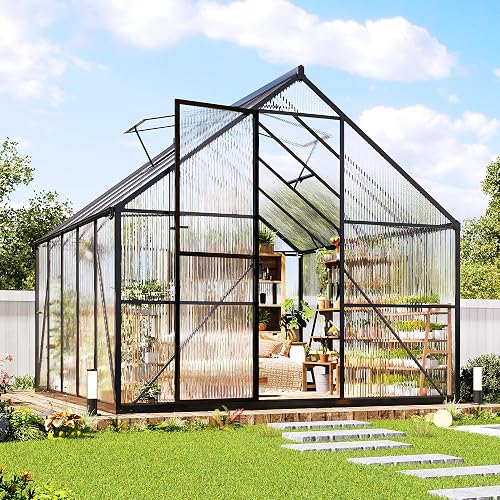 Check it
Jocisland 8x10 FT Walk-in Polycarbonate Greenhouse
Best for fast two-person assembly - 7
 Check it
Esimote 10x12 FT Greenhouse for Outdoors
Best for water management - 8
 Check it
WKM 10x18 FT Walk-in Polycarbonate Greenhouse
Best for large growing projects
The best heavy duty polycarbonate greenhouses for different yards
HOOYEAH is the overall pick because it balances a strong frame with a size that fits most yards. The others win on length, height, rain handling or scale.
HOOYEAH 6 x 6 FT Polycarbonate Greenhouse: Best for small yards and first greenhouses
- Aluminum frame with reinforcement bar
- UV-protected milky polycarbonate panels
- Adjustable roof vent
- Lockable single hinged door
A compact walk-in kit with a sturdy aluminum frame, a roof vent and a lockable door. Best used near fences, walls or shrubs for partial wind protection.
Pros
- Reinforced aluminum frame
- Lockable door and adjustable roof vent
- Panels diffuse light instead of glare
Cons
- Milky panels are not fully clear
- Small footprint for larger harvests
HOOYEAH suits a first-time buyer who wants a walk-in house without dedicating half the garden to it. The 6 x 6 FT kit leaves room for shelves along both walls and a central path.
Its aluminum frame includes a reinforcement bar, which is the detail that separates it from lighter budget kits. The roof vent and lockable door let you manage airflow and keep tools safe.
The panels are milky and semi-translucent rather than clear. That diffuses sunlight for vegetables and herbs and softens the glare you get in a glass house.
It also means you can't see plants as sharply from outside.
The dimensions run about 71 inches long and wide with a 77-inch height, so a tall gardener will clear the doorway. The single hinged door swings out, so leave a clear approach on that side.
HOOYEAH says it works best near fences, walls or shrubs rather than in fully exposed spots. Pick it for a sheltered corner with steady foot traffic.
YITAHOME 12x6FT Polycarbonate Greenhouse Large Heavy Duty: Best for a long growing run in a narrow space
- Aluminum alloy frame with diagonal rod fixation
- Double-wall 4mm polycarbonate boards
- Two adjustable skylights
- Sliding door
A 12-foot run with reinforced side rods, double-wall panels and two skylights. The sliding door saves floor space compared with a hinged swing door.
Pros
- Reinforced frame with diagonal rods
- Two adjustable skylights
- Sliding door saves space
Cons
- Ships in two packages that may arrive separately
- Narrow width limits deep shelving
YITAHOME suits a gardener who wants a long planting bed in a yard that is wider than it is deep. The 12 x 6 FT run fits along a fence line while still leaving a walkway inside.
The frame uses aluminum alloy with reinforced side rods and diagonal fixation. That bracing is what makes a long, narrow house feel solid instead of springy.
Diagonal rods tie the frame together so it resists racking when wind hits the long wall.
Double-wall 4mm polycarbonate boards block UV and hold warmth better than a single sheet. YITAHOME says the panels block about 99% of UV radiation.
Two adjustable skylights and a sliding door handle airflow and access without eating floor space.
The sliding door is the practical win in a narrow house. It slides along the wall instead of swinging into your path.
The tilt-angle roof aids drainage and wind resistance.
It ships in two packages that can arrive on different days, so plan the build around both. The kit weighs about 94 lb, light enough for two people to move panels by hand.
Reljofum 6'x11' Aluminum-Framed Polycarbonate Greenhouse: Best for quick setup
- Quick setup structure
- Aluminum frame
- Roof vent
- Sliding door
A light aluminum kit that goes together fast and still leaves room to walk through. The roof vent helps on warm afternoons.
Pros
- Light kit at about 51 lb
- Roof vent included
- Sliding door
Cons
- Light frame needs careful anchoring
- Modest panel count for the footprint
Reljofum suits someone who wants the greenhouse up this weekend and would rather not wrestle with dozens of small parts. The quick setup structure and sliding door keep the build simple.
At 6 x 11 FT, it gives you more length than the HOOYEAH without the bulk of a 12-foot-wide house. A roof vent handles warm afternoons, and two vents in total give decent cross flow.
The kit weighs about 51 lb, the lightest here. That makes it easy to move into place, but it also means the frame needs firm anchoring before the first windy day.
The dimensions run about 109 inches wide by 47 inches deep, so check your site measurement against the footprint before ordering.
Pick it for a narrow side yard or a community plot where you need a house up fast. Skip it if your site is fully exposed and you want maximum bracing built in.
AMERLIFE 12 x 10 x 8-Ft Hybrid: Best for rain collection and wind exposure
- Hybrid clear and translucent panels
- Gutter system
- Two adjustable roof vents
- Quick-connect frame
A larger hybrid-panel house with gutters that collect rainwater and a frame built for strong winds. The mixed panels give clearer light than a fully milky kit.
Pros
- Gutters collect rainwater
- Hybrid panels balance light and privacy
- Frame rated for high winds
Cons
- Heavy kit at about 245 lb
- Longer build time
AMERLIFE suits a buyer in a windy, rainy area who wants the frame to do more of the work. Its reinforced aluminum frame is built to handle winds up to 56 mph and snow loads up to 18 psf.
The hybrid panel mix is the interesting part. Clear and translucent panels together give brighter light than an all-milky kit while still cutting glare in the middle of the day.
The panels are rated for impact resistance and UV protection as well.
Gutters run along the roof and collect rainwater, which helps you manage humidity and gives you free water for beds. Two roof vents add control, and the kit includes bird spikes for the ridge.
AMERLIFE lists 435 cu. ft. of usable space inside.
It is heavy at about 245 lb and takes longer to build. AMERLIFE puts a full build at about 6 hours with three people.
That weight is the trade-off for the sturdier frame. Choose it if your site gets real weather and you can spare a weekend.
CDCASA 12x10x10 FT Polycarbonate Greenhouse for Outdoors: Best for tall plants and trellising
- 4mm twin-wall panels
- Rust-resistant aluminum frame
- Two windows with five vent angles
- Rain gutters on both sides
A tall 10-foot-high house with twin-wall panels and five-angle window vents. The extra height suits climbing crops and taller pots.
Pros
- Tall 10 ft ridge height
- Two windows with five vent angles
- Gutters on both sides
Cons
- Large kit at about 240 lb
- Wants a solid base or buried feet
CDCASA suits a grower planning tomatoes, cucumbers or anything that climbs. The 10-foot ridge height is the tallest here, so trellises and tall pots fit without bending.
The 4mm twin-wall panels block UV and hold heat, while the rust-resistant aluminum frame handles wet weather. CDCASA says the panels allow about 70% light transmission and block over 99.9% of UV rays.
Two windows with five vent angles let you dial in airflow through the season.
Rain gutters on both sides move water away from the base and can feed a collection barrel. You can attach a hose to the gutter to collect rain for watering.
The kit weighs about 240 lb, so treat it as a two-person build. CDCASA puts assembly at 4 to 6 hours for two skilled DIYers.
Bury the base feet in soil or concrete, or bolt the base to boards, before you load it with plants. CDCASA warns to keep doors and windows closed in strong wind and to reinforce the frame in hurricane areas.
Pick it for height and airflow, not for a quick weekend project.
Jocisland 8x10 FT Walk-in Polycarbonate Greenhouse: Best for fast two-person assembly
- Quick connectors and triple-lock joints
- Cross beams and corner supports
- Two top windows
- 4mm polycarbonate panels
A mid-size kit with tool-free joints and extra bracing at the corners. Two people can put it up in an afternoon.
Pros
- Tool-free quick connectors
- Cross beams and corner supports
- Gable roof sheds water
Cons
- Smaller than the 12-foot options here
- Needs stakes or bolts to hold it down
Jocisland suits a two-person household that wants a mid-size house without a long build. Quick connectors and triple-lock joints mean no tools for the frame, and Jocisland says two people can finish in 2 to 3 hours.
The frame adds cross beams, top braces and corner supports, plus ground stakes and bolts. That bracing matters more than the tool-free joints when the wind picks up.
Two top windows and a gable roof keep air moving and stop water pooling on the ridge. Built-in roof channels drain rainwater to the sides.
The 4mm panels block UV and hold warmth for year-round planting.
At 8 x 10 FT with a 6.7 ft peak, it sits between the compact and large kits here. Jocisland lists base sizes around 8.62 by 10.4 ft, so plan your pad slightly larger than the house.
Pick it if you want a solid mid-size house up in an afternoon and can stake it down properly.
Esimote 10x12 FT Greenhouse for Outdoors: Best for water management
- Built-in drainage channels
- Lockable sliding door
- Adjustable roof vent with five levels
- Reinforced aluminum frame
A large kit with drainage channels you can pipe away from the base. The single five-level roof vent gives you control over airflow.
Pros
- Drainage channels can connect to pipes
- Lockable sliding door
- Five vent positions
Cons
- One roof vent only
- Big footprint for most backyards
Esimote suits a gardener who wants rainwater to go somewhere useful. Built-in drainage channels run along the roof and can connect to pipes, so runoff leaves the base instead of pooling around it.
The 10 x 12 FT footprint gives you room for beds plus a work corner. A single roof vent with five levels and a sliding door let you manage temperature and humidity.
The vent measures about 23.5 inches square and the door about 23 inches wide by 78 inches tall.
The reinforced aluminum frame and lockable metal handle round out a practical kit for a backyard grower. The panels are polycarbonate like the rest, though the single vent means less cross flow than the two-vent models.
Esimote also pitches the space as tool storage or a spot to sit on sunny days.
Pick it for a large, level site where water management matters. Skip it if your yard is small or you want maximum venting built in.
WKM 10x18 FT Walk-in Polycarbonate Greenhouse: Best for large growing projects
- 720 g/m2 polycarbonate panels
- Reinforced aluminum frame
- Adjustable roof vent with five settings
- Lockable door
The biggest kit here, aimed at market-style growing or a full backyard build. The heavier panels and reinforced frame suit exposed sites.
Pros
- Largest footprint in this group
- Heavier polycarbonate panels
- Five vent settings
Cons
- Very large footprint
- Slowest kit to put up
WKM suits someone planning a serious growing project, maybe a small market garden or a full backyard build. At 10 x 18 FT it is the largest kit here by a wide margin.
The footprint runs about 214 inches long by 120 inches wide with a 98-inch height.
The panels are heavier than most at 720 g/m2, and the reinforced aluminum frame is built for wind, rain and snow. Five adjustable roof vents and a lockable metal handle door handle the basics.
The base safety cover adds protection at ground level.
The slide-in panel system speeds up installation and seals the panels tightly. WKM says the system cuts build time by about 30% and adds about 15% more stability.
The support frame can also be adjusted in height.
This is not a kit you put up alone on a Saturday. Pick it when you have help, a big level site and a long-term growing plan.
For smaller yards, the models above make more sense.
How these heavy duty greenhouses compare
The comparison table lines up the eight kits by size, frame and panel type. Use it to match a footprint to your yard before reading the write-ups.
| Product | Best for | Size | Frame | Panels | Our score |
|---|---|---|---|---|---|
| HOOYEAH 6 x 6 FT Polycarbonate Greenhouse | small yards and first greenhouses | 6 x 6 FT | Aluminum | Polycarbonate (PC) | 9.2 |
| YITAHOME 12x6FT Polycarbonate Greenhouse Large Heavy Duty | a long growing run in a narrow space | 12 x 6 FT | Aluminum | Double-wall polycarbonate | 9.2 |
| Reljofum 6'x11' Aluminum-Framed Polycarbonate Greenhouse | quick setup | 6 x 11 FT | Aluminum | Polycarbonate (PC) | 9.1 |
| AMERLIFE 12 x 10 x 8-Ft Hybrid | rain collection and wind exposure | 12 x 10 x 8 FT | Aluminum | Hybrid polycarbonate | 8.8 |
| CDCASA 12x10x10 FT Polycarbonate Greenhouse for Outdoors | tall plants and trellising | 12 x 10 x 10 FT | Aluminum | 4mm twin-wall polycarbonate | 8.5 |
| Jocisland 8x10 FT Walk-in Polycarbonate Greenhouse | fast two-person assembly | 8 x 10 FT | Aluminum | 4mm polycarbonate | 8.3 |
| Esimote 10x12 FT Greenhouse for Outdoors | water management | 10 x 12 FT | Aluminum | Polycarbonate (PC) | 8.0 |
| WKM 10x18 FT Walk-in Polycarbonate Greenhouse | large growing projects | 10 x 18 FT | Aluminum | Polycarbonate (PC) | 7.8 |
A few patterns stand out once the specs sit side by side. The compact and mid-size kits ship light enough for two people to move the panels by hand, while the 12-foot and larger houses cross into the 240 to 245 lb range.
Weight tracks with frame bracing and panel count more than with price.
Vent count splits the group as well. The two-vent kits give you cross flow through summer, and the single-vent kits suit cooler sites where one opening is enough.
Roof pitch and gutters separate the kits that handle rain well from those that need extra caulking.
How we compared these polycarbonate greenhouses
We ranked these kits by frame strength first, then panel type, venting and the real footprint. A kit only counts as heavy duty here if it has bracing beyond a plain tube frame.
Panel thickness and wall type matter as much as the frame. Twin-wall and 4mm panels hold warmth and resist impact better than thin single sheets.
If you are weighing panel options in more detail, our guide to the best polycarbonate greenhouse panels covers thickness and UV coatings.
We also looked at how each kit handles wind and water. Diagonal bracing, corner supports, gutters and vent count all feed into the score.
A kit with one vent loses points against one with two or more.
Finally, we weighed the practical side: kit weight, build time and whether the footprint fits a normal backyard. A sturdier kit that nobody can fit or assemble does not help.
What separates a heavy duty kit from a budget one?
The difference shows up in the frame joints and the bracing, not in the panel color. Budget kits often use thin tubes with simple corner brackets and no diagonal rods.
Heavy duty kits add diagonal fixation, corner supports or cross beams that tie the walls and roof together.
Panel quality follows the same rule. A budget kit may use a thin single sheet that dents easily.
The kits here list 4mm twin-wall or hybrid panels, and the WKM kit goes heavier still at 720 g/m2. Those panels cost more to make and hold heat longer.
Which size fits a typical backyard?
A 6 x 6 FT or 6 x 11 FT kit fits most small to mid-size yards without swallowing the lawn. An 8 x 10 FT kit needs a clear pad and some room to walk around it.
The 10 x 12 FT and larger houses suit bigger plots or a dedicated growing area.
What should you check before buying a heavy duty polycarbonate greenhouse?
Check the frame bracing and the anchoring plan first. Those two details decide whether a kit survives its first storm, whatever the panel type.
Look for diagonal rods, corner supports and cross beams in the frame. A thick tube alone is not bracing.
Then plan how you will fix the base down.
How much wind can a polycarbonate greenhouse take?
Wind ratings vary widely by kit. Some frames are built for winds up to 56 mph, while others only recommend sheltered spots.
If your yard is exposed, choose a kit with a stated wind rating and brace it further with cables or ground anchors. Keep doors and windows closed during strong gusts.
In hurricane areas, reinforce the frame during the build.
Should the base be buried or bolted?
Both work. Burying the base feet in soil or concrete suits a permanent spot and gives the strongest hold.
Several kits here recommend setting the bottom frame in a pre-dug trench before securing the panels.
Bolting to a wooden frame or concrete slab suits a patio or a spot you may move later. Kits that ship with ground stakes and cables are the quickest to secure.
CDCASA and YITAHOME both mention fixing the base down before the panels go on.
How do I keep rain from pooling inside?
Gutters and a pitched roof do most of the work. Roof channels move water to the sides and away from the base.
If your site holds water, connect the gutters to a pipe or barrel. Some kits have built-in drainage channels you can extend.
Caulk the panel-to-frame joints as the maker directs to stop drips. YITAHOME specifically recommends glass glue at the panel and frame connection for better water protection.
How thick should polycarbonate panels be?
Aim for 4mm twin-wall or hybrid panels for a heavy duty build. Thinner single sheets save money but lose heat and dent more easily.
Thicker panels block more UV and hold warmth overnight, which matters in shoulder seasons. The trade-off is weight and a slightly dimmer interior.
Hybrid mixes of clear and translucent panels balance light and privacy.
Panel weight is listed in different ways across kits. The WKM kit states 720 g/m2, while others list only the 4mm wall thickness.
A heavier panel usually means more plastic per square meter and better insulation. The trade-off is more load on the frame.
If you are replacing panels on an existing frame, measure the old sheets before ordering. Our guide to greenhouse plastic sheeting explains when a film cover makes more sense than rigid panels.
Which greenhouse covering holds up best in bad weather?
Polycarbonate panels win for structure and impact resistance. A film cover is cheaper but needs replacing more often.
Polycarbonate handles hail and wind better than glass or film because it flexes instead of shattering. It also holds heat in a twin-wall build.
Our comparison of PE vs PVC greenhouse cover covers the film options if you want a lighter, cheaper cover.
For a frame you already own, a replacement greenhouse cover is often the smarter spend than a whole new kit. Match the cover type to your frame and the weather you get.
How much space do you need for a walk-in polycarbonate greenhouse?
Plan for the kit footprint plus a clear path around it. A 6 x 6 FT house needs about 8 x 8 FT of ground once you allow for access.
Larger kits like the 10 x 18 FT need a serious level area. Leave room to open the door fully and to reach the roof for snow clearing.
Also leave space for a water barrel or hose.
If your yard is small, a compact kit near a fence gives you most of the benefit. Long, narrow sites suit the 12 x 6 FT shape better than a wide square.
A sliding door kit also frees up the approach space that a hinged door needs.
Verdict: which heavy duty polycarbonate greenhouse should you buy?
For most yards, buy the HOOYEAH 6 x 6 FT for its reinforced aluminum frame, lockable door and roof vent in a size that fits. It is the heavy duty polycarbonate greenhouse we would pick first for a typical backyard.
Choose the YITAHOME 12x6FT if you have a long strip of ground and want more growing run. Go with the AMERLIFE or CDCASA when your site gets real wind and rain.
Pick the WKM only if you have a large site, help and a long-term plan. The Jocisland kit sits in the middle when you want a mid-size house up in an afternoon.
Whichever kit you choose, anchor it well and clear snow from the roof. Those two habits protect a heavy duty frame more than any single spec on the box.
Our top 3 picks at a glance
-
1
Best for small yards and first greenhouses
HOOYEAH 6 x 6 FT Polycarbonate Greenhouse
9.2/10 our score
See it on Amazon -
2
Best for a long growing run in a narrow space
YITAHOME 12x6FT Polycarbonate Greenhouse Large Heavy Duty
9.2/10 our score
See it on Amazon -
3
Best for quick setup
Reljofum 6'x11' Aluminum-Framed Polycarbonate Greenhouse
9.1/10 our score
See it on Amazon
Frequently asked questions
What makes a polycarbonate greenhouse heavy duty?
A heavy duty polycarbonate greenhouse pairs a reinforced aluminum frame with thick panels. Look for diagonal bracing, corner supports and panels around 4mm thick, plus a frame rated for wind.
Those details matter more than the size label on the box.
Is polycarbonate better than glass for a sturdy greenhouse?
Polycarbonate panels resist impact and weigh less than glass, so the frame carries less load. Twin-wall or 4mm panels also hold warmth better than a single glass pane.
Glass is clearer, but polycarbonate is the safer choice in windy or hailstorm areas.
Can a heavy duty polycarbonate greenhouse handle snow?
Yes, when the frame is rated for it and you clear snow from the roof. Some kits list snow load figures in pounds per square foot.
In heavy snow country, choose a kit with a stated rating and brush the roof after each storm.
Do I need to anchor a polycarbonate greenhouse?
Yes. Even a reinforced frame can lift in a storm without a fixed base.
Bury the base feet in soil or set them in concrete, or bolt the base to a wooden frame.
Kits that ship with ground stakes and cables are easier to secure quickly.
Where should I place a heavy duty greenhouse in the yard?
Pick a spot with partial shelter from the wind, such as near a fence, wall or hedge. Avoid fully exposed corners where gusts hit the panels straight on.
A little afternoon shade also helps keep summer temperatures down.


